Introduction
If you have bronde hair, that brown-meets-blonde blend that’s become one of the most requested colours at the salon, brassiness isn’t a matter of if; it’s a matter of when. Those unwanted brassy, orange tones can return in as little as a week or gradually develop over the course of a month.
A good purple toner is the easiest way to keep bronde hair looking neutral and bright between salon visits. However, not all formulas deliver the same results, and choosing the wrong one can leave your hair feeling dry, looking dull, or taking on an unwanted purple hue. Here’s what purple toners actually do, how often to use them, and which ones are worth trying.
Purple Toner for Bronde Hair: Quick Facts
| Category | Details |
|---|---|
| Best For | Bronde, brunette-blonde blends, dimensional highlights with warm undertones |
| Why It’s Needed | A brown base pushes warmth through lightened pieces as color fades |
| Best Format | Purple conditioner (gentle) or purple shampoo (stronger, faster results) |
| Use Frequency | Once a week for warm-leaning bronde · Every 10–14 days for neutral bronde |
| Purple vs. Blue | Purple toner suits most bronde shades, while blue toner is best for hair with strong orange or brunette undertones. |
| Watch Out For | Overuse can cause a purple tint or make hair look duller, not brighter |
What Is a Purple Toner and How Does It Work?
A purple toner is exactly what it sounds like: a purple-tinted shampoo, conditioner, or treatment designed to neutralise warm, brassy tones in bronde, blonde, or lightened hair. It works because of a simple principle of colour theory.
On the colour wheel, purple and yellow sit directly across from each other, making them complementary colours; they cancel each other out when combined, the same principle used in colour-correcting makeup. Brassiness in bronde hair often occurs when warm tones from the brown base emerge through the lighter strands, and purple pigments help neutralize that unwanted warmth with each use.
This is also why purple toner isn’t meant to replace your regular shampoo. Its job is depositing just enough pigment to cancel warmth, not to deep clean. Used consistently, it keeps bronde hair from drifting brassy between salon visits.
Bronde vs Balayage vs Highlights: Which Brassies Fastest?
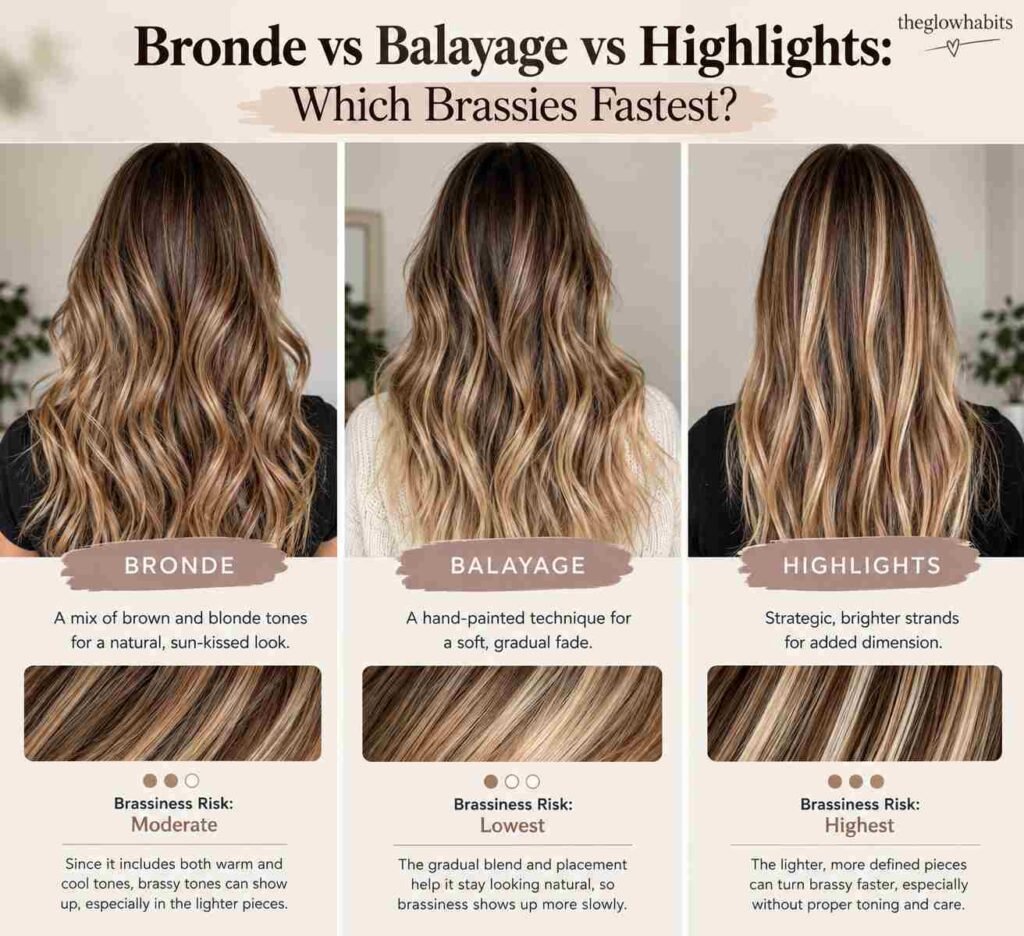
Not all dimensional colours brass at the same rate, and knowing where bronde falls on that spectrum explains why toning routines differ so much.
Traditional highlights, especially chunkier ones near the root, brass the fastest; concentrated, higher-lifted sections show warmth quickly and unevenly.
Balayage tends to develop brassiness more gradually and evenly because its hand-painted highlights create softer colour transitions without heavily lightening any single section.
Bronde sits in between. As a blend of brown and blonde, it doesn’t brass as aggressively as full highlights, but the lightened pieces (especially face-framing) still brass faster than a soft balayage. That’s why bronde needs a consistent, moderate toning routine, not as intense as full highlights but more frequent than balayage.
Purple Toner vs. Shampoo vs. Conditioner
Once you know purple toner works by cancelling out warmth, the next question is which format makes sense for your hair. Shampoo, conditioner, and toner aren’t interchangeable.
Purple shampoo is the harshest of the three. It’s more likely to stain your scalp and, since it still cleanses, it can be more drying. It’s fine if your bronde hair is healthy, but know it’s the most intense option.
Purple conditioner is gentler. If you have fine, dry, or damaged hair, which is common with bronde since it usually involves some lightening, this is often a better starting point. Same brass-cancelling effect, less risk of over-drying.
Salon toner works differently, as your stylist mixes it with a developer and applies it professionally, giving it a much stronger effect than at-home toning products. It corrects brassiness more intensely and lasts longer but fades gradually, which is where at-home purple toner comes in to maintain it.
Think of it this way: salon toner resets your colour and at-home purple toner maintains it in between.
Why Bronde Hair Needs Purple, Not Blue
Brassiness can show up in different ways, and understanding those differences is where many people get confused. The general rule: purple cancels yellow and blue cancels orange, but bronde hair is a special case.
Because bronde sits between brown and blonde, its warmth isn’t quite as orange as a fully brunette base but not as purely yellow as light blonde either. That’s exactly why a richly pigmented purple toner works well here; even though you’d expect blue for darker tones, it cuts through that in-between warmth without the muddy or greyish cast a lighter purple can leave behind.
If your bronde runs deeper and leans more orange than golden. Closer to a brunette base with just a few lightened pieces, a blue-based product may work better. Here’s my full breakdown of the best blue shampoos for brunettes if that sounds like your hair. For most bronde bases, though, purple does the job on its own.
What to Look for in a Purple Toner for Bronde Hair
Not all purple toners are formulated the same way, and picking one without checking a few key details can leave you with either underwhelming results or an overcorrected, purple-tinged mess.
Match the pigment intensity to your bronde level. Purple toners range from light pastel lavender to deep indigo violet. Darker pigments work best for stubborn warmth on bronde with more lightened pieces; lighter tints suit more subtle bronde.
Check the ingredient list for hydration. Purple toners can be drying, since the pigments pull moisture out along with the brass. Choose formulas containing argan oil, shea butter, or keratin amino acids to help maintain moisture and softness, especially since bronde hair combines natural and lightened strands that require different levels of care.
Getting both the right pigment strength and a nourishing formula is what separates a purple toner that works from one that just leaves hair dry and disappointing.
How Often Should You Use Purple Toner on Bronde Hair?
There’s no single answer; it depends on how warm your bronde runs, your hair type, and how often you wash.
As a general rule, once a week works for cool-toned or neutral bronde without overdoing it. Milder formulas with less pigment are suitable for more frequent use.
If your bronde pulls warm quickly, every 10 days to two weeks with a toning conditioner is often the better balance, enough to catch brassiness early without over-drying from frequent shampoo use.
If you wash your hair daily, purple conditioner is a gentler choice than purple shampoo, as it can be used more regularly without increasing dryness as much.
Bottom line: start with once a week, then adjust based on how your bronde looks and feels.
Best Purple Toners for Bronde Hair
These picks are based on real testing, application, cleansing ability, and how effectively each one cancelled out brassiness over repeated washes on bronde and brunette-adjacent hair.
Best Overall
A keratin-infused purple shampoo checks every box for bronde hair specifically. It lathers easily, doesn’t stain hands or skin during application, and delivers a noticeable brightening effect without leaving hair feeling dry or stripped, a common trade-off with many purple formulas.
It effectively cleanses while keeping hair soft and nourished, making it an excellent all-around choice for neutralizing the warm tones that appear in bronde hair. This one works especially well for medium bronde with a balanced mix of brown and blonde pieces.
Best Conditioner-Based Toner
For bronde that pulls warm quickly but is still purple-appropriate (not fully brunette-orange), an intensely pigmented toning conditioner is worth having on hand. A small amount goes a long way, so one jar can realistically last well over a year with regular use.
It’s not the most hydrating option out there, but it cancels warmth effectively after just one use. It’s a strong pick if your bronde sits on the warmer end of the purple range covered earlier, rather than needing a blue-based product. Since the formula isn’t especially creamy, it works best on already-detangled hair.
Best for Hydration
Marketed more as a treatment than a traditional conditioner, this option is lightweight yet deeply hydrating, leaving hair feeling noticeably softer without any heaviness. It’s the strongest pick for bronde with heavier face-framing lightening, where the lightened pieces tend to be drier than the rest of the hair and need more moisture alongside the toning.
Best Budget-Friendly Option
You don’t need a high-end product to get solid toning results. A wallet-friendly toning conditioner from a well-known drugstore haircare brand comes in a generous bottle that lasts for months, all for less than $25. It’s gentler than shampoo, which makes it a smart pick if you’re trying to avoid the drying effects that come with more frequent toning a good starting point for lighter, more subtle bronde that only needs occasional toning.
What Happens If You Overuse Purple Toner?
More isn’t always better. Overusing purple toner can work against the results you want, especially on bronde, where you’re balancing warmth across two base tones.
The most immediate risk is a visible purple tint. Too frequent use, or leaving it on too long, can build up pigment into a noticeable purple or greyish cast. The good news: it’s reversible. Just dial back usage until the excess washes out.
Purple toner also doesn’t lighten hair. It only cancels warmth. Overusing it can actually make bronde look darker or duller over time, not brighter.
If your colour looks dull, reaching for more purple toner is usually the wrong move. Dullness is often from product buildup or hard water, not a lack of toning. Dermatologists note that mineral buildup and environmental exposure can dull hair color over time — a clarifying shampoo is usually the better fix, resetting your hair before your normal toning routine.
For genuinely lighter bronde, that requires a salon lightening service; overtoning at home is never a shortcut; it just risks muddying your colour. For extra shine on top of toning, I also tested one of my favourite in-shower gloss treatments here.
FAQ
Not necessarily. One toning product is usually enough to keep brassiness in check — if you’re still noticing warmth afterward, that often just means it needs a few more minutes on your hair, not a second product.
No. It only cancels out warm tones — it has no lifting power. If you want lighter hair, that requires an actual salon lightening service.
Follow the product’s instructions, usually a few minutes. Leaving it on longer than recommended raises the risk of a purple tint, especially with more pigmented formulas.
Dullness is often caused by product buildup or hard water, not a lack of toning. Try a clarifying shampoo first to reset your hair before going back to your usual toning routine.
Conclusion
Purple toner isn’t complicated once you understand what it’s actually doing for bronde hair: specifically canceling out that in-between warmth, not lightening or deep-cleaning your color. The real key is matching the right formula and frequency to how warm your bronde actually runs, whether that means a stronger toner once a week or a gentler conditioner worked into a more frequent routine.
Start with a formula that fits your hair’s needs, watch how your color responds, and adjust from there. Done right, it’s one of the easiest ways to stretch the time between salon visits without your bronde ever looking brassy in between.

