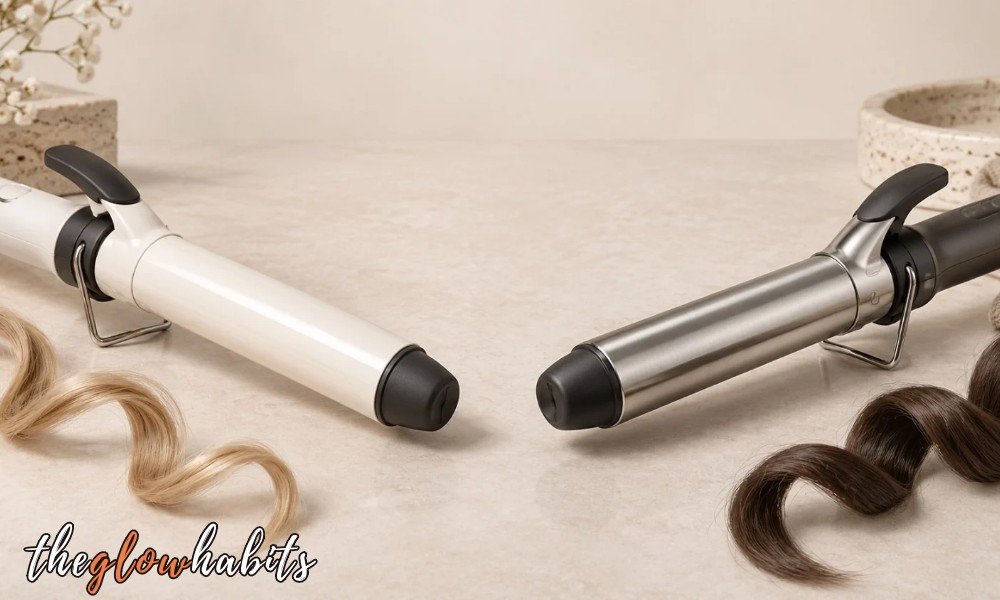
Ceramic vs. titanium curling irons: Which one is right for your hair? Ceramic is usually the gentler, more forgiving choice for fine, damaged, or frequently styled hair, while titanium often suits thick, coarse, or hard-to-curl hair when used with careful temperature control.
Curling irons have changed a great deal since the hand-me-down Conair titanium iron I started using in middle school. That tool lasted 15 years before the buttons failed, so I assumed replacing it would be simple. It was not. With fine, stick-straight hair, I could not reproduce my stylist’s results at home until I stopped asking which material was universally better and started asking which tool fit my hair, routine, and desired hold.
That distinction matters. Ceramic and titanium describe part of a curling iron’s construction, but the material name alone does not determine safety or performance. The heater, temperature sensor, barrel coating, minimum setting, section size, contact time, and condition of your hair all influence the result.
Ceramic vs Titanium Curling Iron at a Glance
There is no one-size-fits-all winner. Ceramic is the sensible starting point for most people who value controlled, regular styling, while titanium can be useful when resistant hair needs efficient heat and stronger curl retention. These are tendencies, not guarantees; two well-designed tools made from different materials can perform more similarly than two poorly and well-designed tools carrying the same material label.
| Comparison point | Ceramic curling iron | Titanium curling iron |
| Typical heat behavior | Often designed for steadier, more even heat | Often designed for rapid heating and quick heat recovery |
| Best starting match | Fine, fragile, color-treated, damaged, or frequently styled hair | Thick, coarse, dense, healthy, or hard-to-curl hair |
| Forgiveness | Usually easier for beginners and careful everyday styling | Less forgiving if the iron becomes very hot quickly |
| Curl finish | Often associated with smooth, polished curls | Often chosen for firm, long-lasting curl formation |
| Styling pace | May take longer to preheat | Often reaches the selected setting faster |
| Main caution | Ceramic coatings can gradually wear down or chip, exposing the underlying material. | Rapid high heat can encourage unnecessary temperature or repeated exposure |
| Price | Available at budget and premium prices | Available at budget and premium prices |
| Best use | Regular styling at the lowest effective heat | Occasional or efficient styling of resistant hair with close heat control |
The most important takeaway is simple: hair condition comes before hair type. Thick hair that is bleached, brittle, or already breaking should not be treated like healthy coarse hair merely because it feels dense. Likewise, fine hair that resists every curl may need better sectioning, cooling, and hold technique before it needs a hotter tool.
How Ceramic Curling Irons Perform
A ceramic curling iron features a ceramic barrel, a ceramic-coated surface, or a heating system that uses ceramic technology. Those constructions are not interchangeable. A solid or thicker ceramic component may retain its surface characteristics longer than a thin coating, but heater quality and temperature regulation still matter more than a vague “ceramic” label.
Ceramic benefits
Ceramic models are commonly built to spread heat steadily across the barrel. That controlled feel can make them easier to use on fine hair, fragile strands, color-treated hair, or hair styled often. A smooth, intact surface may also reduce snagging and make product residue easier to clean away.
Many ceramic styling tools also feature ionic technology, which helps reduce frizz and enhance shine for a smoother finish. Treat that as a model-specific feature rather than a property every ceramic iron automatically delivers. Titanium tools can also include ionic technology, so “negative ions” should not be the deciding factor without a clear specification from the manufacturer.
For regular home styling, ceramic’s practical advantage is predictability. I reach for it when I want a polished finish, when humidity or static makes frizz more noticeable, or when I expect to take photos and care more about smoothness than maximum hold.
Ceramic drawbacks
Some ceramic irons take longer to preheat than comparable titanium models. Ceramic-coated barrels can also wear over time, particularly when the coating is thin, repeatedly scraped, or cleaned with abrasive products. Inspect the barrel periodically and stop using a tool that is chipped, rough, or catching hair.
Ceramic irons may not be the best choice for very straight, hard-to-curl hair. In my experience, they create smooth, polished curls, but the results don’t always last as long on fine, straight hair as they do with a titanium iron set to the right temperature. That does not justify jumping to the highest setting; it means curl preparation and cooling should be tested before increasing heat.
How Titanium Curling Irons Perform
Titanium curling irons use titanium in the barrel surface or coating and are often marketed for fast heat-up, durability, and lightweight handling. Titanium itself is strong, relatively light, and highly corrosion-resistant, according to the Royal Society of Chemistry. A curling iron’s real-world durability, however, still depends on how much titanium it contains, the coating quality, and the overall construction.
Titanium benefits
A responsive titanium tool can be valuable for thick, coarse, dense, or hard-to-curl hair because it tends to regain heat quickly between sections. This efficiency can help set curls more effectively, reducing the need to repeatedly style the same section of hair. Lightweight construction can also reduce arm fatigue when styling a large amount of hair.
Titanium has given my stick-straight hair the most dependable long-lasting curl, particularly for an event. My old Conair iron was inexpensive, consistent, and unusually durable. That personal result is useful evidence for my hair—not proof that titanium is best for everyone.
Titanium drawbacks
Fast heat is both the attraction and the risk. A curling iron that heats up rapidly leaves less time to realize the temperature is set too high. Poor temperature regulation or a worn surface can also produce inconsistent styling, snagging, dryness, frizz, or breakage. Hot spots are not exclusive to titanium, but rapid high heat makes careful handling especially important.
Titanium is therefore a better fit for someone who understands their hair’s response, watches contact time, and uses the lowest setting that produces the desired curl. Fine, bleached, fragile, or already damaged hair generally needs a more cautious approach, regardless of the material printed on the box.
A Practical Three-Check Decision Method
First, check condition rather than relying on texture labels. Run your fingers along a clean, dry strand and consider recent bleach, color, chemical services, split ends, roughness, and breakage. If the hair is compromised, choose the more controllable tool and the lowest effective setting; when damage is significant, pause heat styling and ask a board-certified dermatologist or qualified hair professional for guidance.
Second, identify the failure you are actually trying to solve. If curls drop quickly but the hair still feels soft, improve section size, tension, cooling time, and hold product before adding heat. If the curl lasts but the hair feels dry, stiff, or rough afterward, the problem is exposure—not a lack of power. This single distinction prevents many unnecessary tool upgrades.
Third, match the tool to frequency. Frequent styling rewards low minimum temperatures, stable controls, smooth barrel condition, and an automatic shutoff more than maximum heat. Occasional styling on healthy, resistant hair may justify titanium’s speed and hold, but only when the temperature is controlled and every section receives one deliberate pass.
Finally, compare actual models rather than buying a material word. Look for the stated barrel construction, minimum and maximum settings, number of adjustments, digital or dial control, warranty, return policy, barrel length, and replacement support. Test a small hidden section at the lowest setting first. If two irons create the same curl, choose the one that does it at the lower temperature with less snagging.
Safer Heat Settings and Technique
No chart can declare one temperature safe for every head of hair. The American Academy of Dermatology warns that excessive heat can damage every hair type and recommends low or medium heat, brief curling-iron contact, and less frequent use. Its broader hair-damage guidance also advises using the lowest heat setting and limiting how long the tool touches the hair.
Common online guides often suggest 250–300°F (120–150°C) for fine or damaged hair, 300–350°F (150–175°C) for normal hair, and 350–400°F (175–200°C) for coarse or extra-thick hair. These are not universal safety limits. Hair history, moisture, tool accuracy, section size, and contact time can make the same displayed temperature behave very differently.
| Hair condition or texture | Better starting approach | Reason |
| Bleached, fragile, breaking, or visibly damaged | Avoid unnecessary heat; if styling, begin at the tool’s lowest setting and use one brief pass | Compromised strands have less room for error |
| Fine or easily styled | Begin low and increase only if the curl does not form | Fine strands often need less energy and contact time |
| Medium or untreated | Start with a low-to-medium heat setting and test it on a small, hidden section of hair first. | A test reveals whether more heat is truly necessary |
| Thick, coarse, dense, or resistant | Begin at medium heat; increase gradually only when a lower setting fails | Texture may need more heat, but the lowest effective setting remains the goal |
Use this sequence with either material:
- Start with completely dry, detangled hair.
- Apply a heat-protective product exactly as its label directs and let the hair dry again if the product is damp.
- Select the lowest setting and test one small, hidden section.
- Use neat sections so the barrel contacts the hair evenly; do not compensate for an oversized section with more time.
- Keep contact brief. If the curl does not form, let the hair cool before adjusting one variable—section size, contact time, or temperature.
- Let each curl cool before brushing or separating it.
- Stop if you notice smoke, a burning smell, new roughness, unusual breakage, or a barrel that catches the hair.
Heat protectant helps minimize damage, but it cannot fully shield your hair from excessive heat. If you regularly need the highest setting or repeated passes, the styling method, barrel size, or tool may be wrong for the result you want.
Using a Curling Iron With or Without the Clip
A clip iron can create both structured curls and loose waves. The safest technique is the one you can control without touching the hot barrel, twisting the hair tightly, or holding it in place longer than necessary.
Use the iron as a wand for relaxed waves
With the clip closed and out of the way, wrap a small section around the barrel without overlapping the hair. Leave the ends slightly straighter for a relaxed finish, alternate directions for movement, and wear the heat-resistant glove supplied by the manufacturer. This clamp-free method creates soft, natural-looking waves, but it demands extra attention to finger placement.
Use the clip for polished, bouncy curls
Open the clamp, place a neat section inside it, and roll without trapping or sharply creasing the ends. Smaller sections generally create more defined curls; larger sections create a looser bend. Release gently rather than pulling the iron through the strand, then allow the curl to cool in shape.
Barrel size influences the result as much as material. A narrower barrel forms tighter curls, while a larger barrel creates loose curls or waves. An extra-long barrel can make long or dense hair easier to section, but it does not make a tool safer or more effective by itself.
Product Examples and Buying Criteria
These examples show how differently brands describe ceramic and titanium tools; they are not a universal ranking.
- The T3 SinglePass Curl X 1-inch curling iron features an extended CeraGloss ceramic barrel and digital temperature controls for consistent, precise styling. It is a premium ceramic example for shoppers who value a long barrel and multiple controls.
- Conair sells ceramic and titanium options across several price points. Its official curling-iron collection is useful for comparing barrel size, controls, and construction rather than assuming every tool from one brand performs alike.
- The BaBylissPRO Nano Titanium 1-inch Curling Wand is a titanium wand designed for long-lasting curls. Because it has no clip, handling and glove use matter as much as the barrel material.
- The PATTERN Interchangeable Curling Iron includes three tourmaline-ceramic barrels for different curl sizes. Interchangeable barrels can add versatility, but each attachment still needs an appropriate setting and careful contact time.
Before buying, check these details:
| Feature | What to verify | Why it matters |
| Barrel construction | Solid material, coating, blend, or vague marketing language | Coatings and full-material barrels age differently |
| Temperature range | The minimum setting, not only the maximum | Fine or compromised hair needs meaningful low-heat control |
| Temperature control | Digital display, dial markings, and number of settings | Precise adjustments are easier to repeat |
| Barrel condition | Smooth surface with no chips, rough patches, or exposed edges | A damaged surface can snag hair |
| Safety features | Automatic shutoff, stand, cool tip, and included glove | These reduce handling and household risks |
| Barrel dimensions | Diameter and heated length | Size affects curl shape and how easily long hair fits |
| Warranty and returns | Coverage period and trial or return terms | Real testing is often the only way to confirm compatibility |
Frequently Asked Questions
Ceramic is usually the better starting choice for fine, fragile, damaged, or frequently styled hair, while titanium often works well for healthy, thick, coarse, or resistant hair. The better tool is the one that creates your desired curl at the lowest effective temperature without snagging.
Ceramic is generally more forgiving because many ceramic tools are designed for steadier heat delivery. Damaged hair may still need a break from heat, and any iron should be used briefly at the lowest effective setting.
Titanium can be a strong match for thick, coarse, dense, or hard-to-curl hair because many models heat and recover quickly. Start lower than you think you need, test one section, and increase the setting only when the curl does not form.
Titanium is not automatically damaging, but fast access to high heat can make a titanium iron less forgiving. Temperature, contact time, frequency, barrel condition, and technique influence damage more directly than the material name alone.
Use the lowest temperature that forms a curl with one brief pass. Begin at the bottom of your tool’s range, test a hidden section, and increase gradually only if needed; there is no single safe temperature for every hair type.
Work on completely dry hair, use smaller even sections, choose a barrel size that matches the curl you want, and let every curl cool before separating it. A lightweight styling product and less handling can improve hold without adding more heat.
Solid ceramic may avoid some coating-wear concerns, but it is not automatically the better iron. Temperature accuracy, heater design, surface smoothness, warranty, and how the tool performs at low heat are equally important.
No. Ceramic and titanium tools may both include ionic technology, and performance varies by model. Treat negative-ion language as one feature to verify, not as proof that one barrel material will suit every head of hair.
Final Verdict
Ceramic curling irons are best for gentle, regular styling, while titanium works well for thick or hard-to-curl hair. Whichever you choose, use the lowest effective temperature and a heat protectant to keep your curls healthy.
