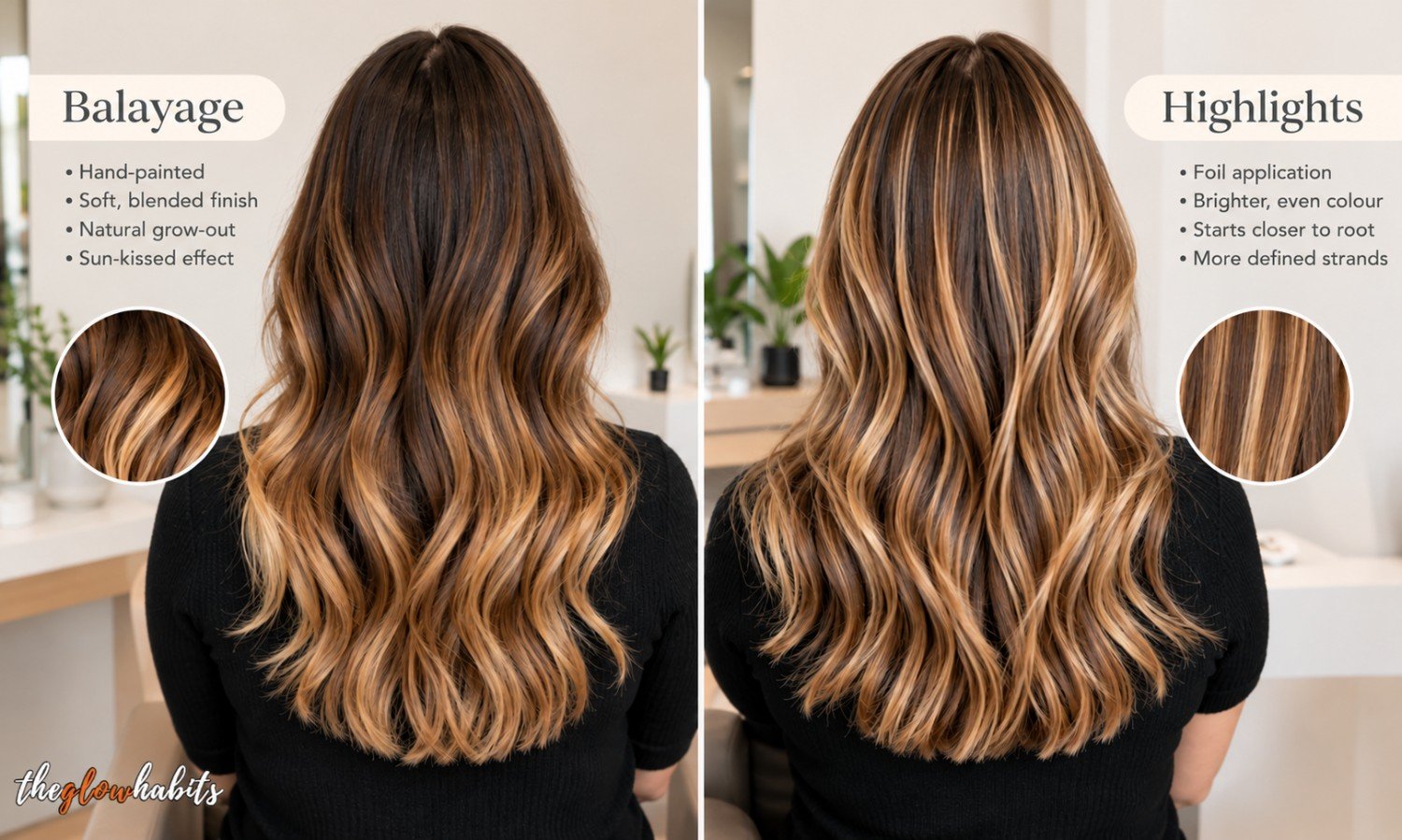
What is the difference between balayage and highlights? Balayage is hand-painted for a softer, blended grow-out, while highlights use foils for brighter, more uniform lift from root to tip.
Choosing between balayage and highlights is not really about which technique is better. It is about which result fits your hair, routine, and idea of beautiful colour. One gives the colourist freedom to paint light through selected areas; the other isolates precise strands for controlled brightness. Both can look natural, both can look bold, and both depend on thoughtful placement.
If you are planning a salon visit, use this guide to compare the finish, maintenance, cost factors, and suitability of each method before you sit in the chair.
Quick Decision
- Choose balayage for softer root blending, flexible placement, face-framing dimension, and a lived-in finish.
- Choose highlights for brighter roots, precise strand placement, stronger lift, and a more uniform pattern.
- Combine both when you want freehand softness with the extra lift or control of foils.
Balayage vs Highlights at a Glance
| Factor | Balayage | Highlights |
| Application | Lightener or color is painted freehand onto selected sections. | Selected strands are usually isolated and wrapped in foil. |
| Starting point | Often begins away from the root or is softly feathered near it | Can begin close to the scalp and continue from root to tip |
| Finished look | Soft, blended, sun-kissed, and less uniform | Brighter, more even, structured, and clearly defined |
| Root grow-out | Usually appears gradual and diffused | Often creates a more visible line as new hair grows |
| Lift | Best known for controlled surface lightening and dimension | Foil isolation can support stronger, more consistent lift |
| Maintenance | Often allows more time between major lighting appointments | Usually needs earlier root maintenance if the color begins at the scalp. |
| Best suited to | Soft dimension, face framing, natural-looking roots, and flexible placement | Visible brightness, even color, a light-blonde finish, and accurate placement |
What Is Balayage?
Balayage is a freehand hair-colouring technique. The name comes from a French word meaning “to sweep”, which describes how a colourist paints lightener across the surface of chosen sections. Rather than following one strict pattern, the colourist adjusts the angle, saturation, and position of every painted piece. Hair highlighting includes several application methods, and balayage is one of the best-known approaches.
The color is often lighter through the mid-lengths and ends, with a softer transition near the roots. This produces the sun-kissed dimension many clients associate with balayage. It can be subtle, high-contrast, face-framing, full-head, or partial, so balayage describes the application method rather than one fixed result.
Balayage can suit straight, wavy, curly, fine, thick, light, or dark hair when the placement is adapted properly. Texture matters because light catches every curl, wave, and layer differently. A thoughtful colourist paints for the haircut and natural movement instead of copying the same pattern onto every client.
What Are Highlights?
Traditional highlights lighten selected strands from the root area through the ends. A colourist weaves or slices sections, applies lightener or color, and usually encloses each section in aluminium foil. Foil separates the product from nearby hair, allowing the colourist to control exactly where the color goes and how intensely it develops.
Highlights tend to create a more even pattern than balayage. Fine babylights can look delicate and natural, while wider slices or thicker weaves create stronger ribbons of brightness. Lowlights may be added beside highlights to restore depth and contrast rather than making every strand lighter.
Foil highlights are often useful when a client wants a larger color shift, brightness close to the scalp, or a more uniform blonde result. Expert colorists Abby Haliti, George Papanikolas, and Gina Rivera discuss these practical differences in this balayage and highlights comparison.
Seven Key Differences Between Balayage and Highlights
Application
Balayage relies on freehand painting. Highlights rely on sectioning and foil isolation. That distinction changes where light appears, how softly it begins, and how evenly it travels through the hair.
Finished Effect
Balayage usually creates a graduated effect with a softer blend between the natural base and lighter pieces. Highlights normally create clearer, repeated ribbons of brightness. A skilled colorist can make either result subtle or dramatic, so the consultation matters more than the trend name alone.
Brightness and Lift
Foils can help the lightener remain concentrated around a strand, which is useful for stronger or more uniform lift. Balayage is often chosen for dimensional brightness rather than identical lift in every section. Starting color, previous dye, hair condition, and the lightener used will affect the result.
Root Appearance
Balayage is usually blended around or below the roots, creating a softer, more natural-looking grow-out. Traditional highlights commonly begin closer to the scalp, so the contrast between new growth and lightened hair may become visible sooner.
Appointment Timing
Balayage often gives clients more flexibility between major lightening sessions because the root transition is softer. Highlights may need earlier touch-ups when maintaining brightness from the scalp. There is no universal schedule: contrast, growth rate, toning needs, and personal preference all matter.
Customisation
Balayage gives the stylist broad freedom to flatter the face shape, haircut, and natural movement. Highlights give precise control over the number, width, direction, and spacing of lightened strands. Neither method is limited to one hair type.
Cost Factors
The technique name alone does not determine the bill. Hair length, density, starting color, previous dye, amount of lightener, toner, treatment, stylist experience, and appointment time all affect price. If you are comparing a balayage service in Singapore, ask whether the quote includes toner, bond-support treatment, blow-dry, and any follow-up gloss.
What the Service Name Does Not Tell You
“Balayage” and “highlights” describe application choices, but neither word tells you the final tone, exact brightness, health of the hair, total appointment time, or full maintenance cost. Two clients can request balayage and leave with very different results because their starting color, haircut, density, previous dye, and contrast goals are different.
The clearest consultation language combines a technique with a visual result. Instead of asking only for balayage, ask for “soft face-framing brightness with a natural root.” Instead of requesting highlights alone, describe whether you want fine, blended ribbons or bold, high-contrast pieces. This gives the stylist a useful destination rather than a fashionable label.
Which Technique Should You Choose?
Choose Balayage If You Want
- A soft, sun-kissed finish
- Dimension that does not follow a rigid pattern
- Face-framing brightness
- A gentler-looking root transition
- More flexibility between major lightening appointments
- Color placement tailored to layers, curls, or natural movement
Choose Highlights If You Want
- Brightness that begins close to the scalp
- A uniform or structured blonde pattern
- Precise control over every lightened section
- A stronger shift from dark hair toward a lighter result
- Fine baby lights, bold slices, or an even distribution of color
- Predictable placement from root to tip
Can You Combine Balayage and Foils?
Yes. Many colourists combine them when one method cannot create the entire desired result. Foilage uses balayage-style painting with foil processing to increase lift. American tailoring begins with selected foils and adds freehand color between them to soften the finished blend. The names matter less than a clear plan for placement, contrast, and upkeep.
Is Balayage Better Than Highlights for Your Hair?
Neither is automatically better or safer. The right choice depends on your starting color, chemical history, hair condition, desired contrast, and willingness to return for maintenance. Balayage may be the better fit when you prefer a softer grow-out. Highlights may be better when you want brighter roots, even coverage, or a more noticeable transformation.
Hair length can influence the application without deciding it completely. Longer hair gives a colorist more space for a gradual sweep, while shorter hair can benefit from carefully placed foils near the scalp. Texture also changes how the color is seen: on curls, strategic surface pieces may define movement; on straight hair, even small placement differences can appear more obvious.
A professional hair colour consultation should cover your current base, previous color, inspiration photos, maintenance budget, and realistic level of lift. Bring photographs of looks you enjoy, but also explain what you dislike about your current hair. That second detail often helps the stylist more than the inspiration image alone.
Maintenance and Aftercare
Fresh color stays attractive when the maintenance plan is realistic. Ask the colorist when you will need a toner, gloss, root refresh, or full lightening appointment. A gloss can renew shine and refine tone between larger services, while a root-focused appointment may maintain traditional highlights without repeating lightener through already-lightened ends.
| Maintenance need | Balayage | Highlights |
| Root appearance | Usually grows out with a softer transition | May show a clearer line when highlights begin at the scalp |
| Tone and shine | A toner or gloss may refresh warmth and shine | A toner or gloss may keep blonde pieces balanced and bright |
| Major lightening | Often scheduled according to the desired contrast and placement | Often scheduled around visible root growth and brightness goals |
| Home routine | Color-safe cleansing, conditioning, heat protection, and tone care as needed | Color-safe cleansing, conditioning, heat protection, and tone care as needed |
At home, choose shampoo and conditioner intended for color-treated hair. Toning shampoo can help manage unwanted warm-looking tones in some blonde results, but it should be used according to the product directions. Too much toning product can leave the color looking flat or temporarily over-toned.
Heat styling and sun exposure can make colored hair feel drier or look less vibrant, so use suitable heat protection and avoid unnecessary high temperatures. A detailed colour-treated hair aftercare guide can support the plan your stylist gives you.
Hair dye and lightener must be used carefully. The U.S. Food and Drug Administration advises consumers to follow label directions, perform the recommended skin test, and avoid coloring an irritated, sunburned, or damaged scalp.
When to Pause Before Lightening
Postpone the service and seek professional advice if the scalp is irritated, sunburned, broken, or reacting to a product. Tell the colorist about recent bleach, permanent dye, relaxers, perms, keratin services, metallic-salt color, or at-home box dye. A strand assessment and an honest chemical history are far more useful than promising a shade that the hair cannot safely reach in one visit.
A Better Way to Decide: The Three-Clock Test
The root clock asks how quickly you notice and dislike new growth. If a visible root line bothers you within a few weeks, soft balayage placement may feel calmer. If you love fresh brightness at the scalp and are comfortable booking regular appointments, foil highlights may give you the crisp result you enjoy. This is not about being high- or low-maintenance; it is about choosing a result that will still feel good halfway through its grow-out.
The salon clock measures time as well as money. Instead of asking only for the price of the first appointment, ask what the full year may involve: lightening sessions, toners, glosses, treatments, trims, and home care. A cheaper first service can become the more demanding option if it needs frequent correction, while a carefully planned color may cost more initially but fit your calendar better.
The style clock considers how long you genuinely want the same visual effect. Balayage is useful when you want evolving, lived-in dimension; highlights suit clients who enjoy a repeated, recognizable pattern of brightness. If you change your mind often, ask for reversible placement around the face before committing to a full transformation. A wise stylist plans not only for the photograph taken today, but also for how the color will look as it grows, fades, and moves with your everyday styling.
Questions to Ask During Your Salon Consultation
- Which technique works best for my current hair colour and chemical treatment history?
- How light can my hair safely become in one appointment?
- Where will the lightest pieces be placed?
- Will the result look soft, uniform, dimensional, or high-contrast?
- How will my roots look as the color grows out?
- What maintenance will I need during the next six months?
- Does the quoted price include toner, gloss, treatment, and styling?
- Which home-care products are genuinely necessary?
- Can we begin with a partial service before committing to full color?
If you are ready to compare a plan with your budget and schedule, review the salon’s hair colour pricing before booking.
Sources and Editorial Notes
- U.S. Food and Drug Administration: Hair Dyes — consumer safety, label directions, skin testing, and scalp precautions.
- Hair Cosmetics: An Overview, International Journal of Trichology — peer-reviewed background on hair cosmetics, dyes, shampoos, and conditioners.
- Balayage vs. Highlights, Byrdie — technique, suitability, placement, and maintenance insights from professional colorists.
- Hair Highlighting, Wikipedia — general terminology and historical background.
This guide separates established technique information from the original “three-clock test” decision framework. It was reviewed for clarity and source accuracy on September 12, 2026. Salon methods and product instructions vary, so the final plan should be confirmed with a qualified colourist who can assess the hair directly.
Frequently Asked Questions
Balayage is painted freehand to create a softer, graduated blend, while traditional highlights use sectioning and foils to create more even brightness from the root toward the ends.
Neither is universally better. Balayage often suits clients who want natural-looking dimension and softer grow-out, while highlights suit clients who want brighter roots, precise placement, or a more uniform result.
Balayage often allows more time between major lightening appointments because its root transition is softer. The actual schedule depends on contrast, hair growth, toner needs, and the finish you want to maintain.
Both techniques can cause damage when lightener is overused or aftercare is poor. Hair health, product strength, processing time, overlapping applications, heat exposure, and previous chemical treatments are more important than the technique itself.
Foil highlights can provide stronger, more even lift, while balayage can create softer contrast and dimension on dark hair. A strand assessment is needed because previous dye and hair condition affect how light the hair can safely become.
Yes. Hybrid methods such as foilyage combine freehand placement with foil processing, allowing a colourist to create soft placement with additional lift where needed.
Yes, balayage placement can use permanent or demi-permanent color when the goal and starting shade allow it. Noticeable lightening on darker hair usually requires a lightener, so the formula depends on the current color and desired result.
Prices vary by location, hair length, density, starting color, stylist experience, product use, and appointment time. Ask for a quote that states whether toner, treatment, styling, and follow-up maintenance are included.
Final Thoughts
Balayage suits soft, natural dimension and gentler grow-out, while highlights create brighter, more structured colour. The best choice depends on your hair condition, style, budget, and maintenance routine, so confirm the plan through a hair colour consultation before booking.

